Are you a Fort Worth veteran seeking to establish a service-connected disability?
At Glover Luck LLP, we pursue every route to service connection the evidence allows, and we have done that work for veterans since 2014.
If the VA denied your claim, or granted it at a level that does not reflect what the condition has cost you, both determinations can be challenged. Our Fort Worth, TX service-connected disability lawyer examines which routes to service connection the record opens, develops the evidence each route requires, and pursues the evaluation the rating criteria support. Glover Luck LLP has represented veterans in disability matters since 2014. Consultations are provided at no cost.
Service-Connected Disability Lawyer Fort Worth, TX
A service-connected disability is a condition the VA has determined was incurred in or aggravated by military service. That determination is what opens the door to monthly compensation, and it governs eligibility for a range of other benefits extending to a veteran’s dependents and survivors.
Establishing that connection is the central task, and there is more than one way to accomplish it. A condition may be linked to service directly, presumed connected because of where and when a veteran served, connected to an existing service-connected condition, or established through aggravation of something that predated enlistment. Our service-connected disability attorneys in Fort Worth assess each route before filing, because a claim developed under the wrong theory can fail on evidence that would have supported it under another.
Types of Service-Connected Disability Cases We Handle in Fort Worth, TX
Service connection underlies nearly every claim the VA decides, which means these matters cover the full range of conditions veterans bring to us. Some involve a single condition and a straightforward record. Others involve several conditions, decades of history, and a file the agency has already worked through more than once. The matters below reflect the work our Fort Worth attorneys perform in this area.
- Service connection. Establishing the link between a current condition and military service is the foundation of the claim. We develop the service records, medical evidence, and lay statements that link requires.
- VA disability compensation. The assigned percentage determines the monthly award and the benefits that follow from it. We measure the assigned evaluation against the documented severity of the condition.
- VA individual unemployability. Where service-connected conditions prevent sustained employment, a total rating may be available even when the combined percentage falls short. These claims rest on work history alongside medical evidence.
- Post traumatic stress disorder (PTSD). PTSD carries its own evidentiary rules for establishing the underlying event, and several routes exist depending on the circumstances of service. We identify which route the record supports.
- Mental health disorders claims. Depression, anxiety, and related conditions are evaluated under a single framework measuring interference with work and relationships. Documentation of daily functioning drives the outcome.
- VA TBI. Brain injury claims depend on detailed cognitive findings, and residual effects are frequently evaluated across more than one body system. We examine whether each residual has been separately addressed.
- Agent Orange exposure. Conditions associated with herbicide exposure may be presumed service connected for veterans who served in designated locations. Establishing qualifying service is often the decisive question.
- Gulf War Syndrome claims. Undiagnosed illness and chronic multisymptom illness may be compensable without a diagnosis. These claims proceed under a framework built for conditions medicine cannot explain.
- Section 1151 claims. Additional disability caused by VA medical care may be compensated as though it were service connected. These claims are decided on the treatment record.
- Camp Lejeune water contamination. Exposure to contaminated water at Camp Lejeune has been associated with several serious conditions. Veterans and family members may have entitlements arising from that exposure.
Why Choose Glover Luck LLP as My Service-Connected Disability Lawyer in Fort Worth, TX?
Every Route to Service Connection Considered
A claim denied under one theory may succeed under another, and a denial that addressed only the most obvious route is frequently reviewable on that ground alone. We examine whether a presumption applies, whether the condition flows from one already rated, whether service aggravated something that predated enlistment, and whether VA care contributed. That review is often where a previously denied claim finds new footing.
Founders Whose Preparation Extends Beyond the Law
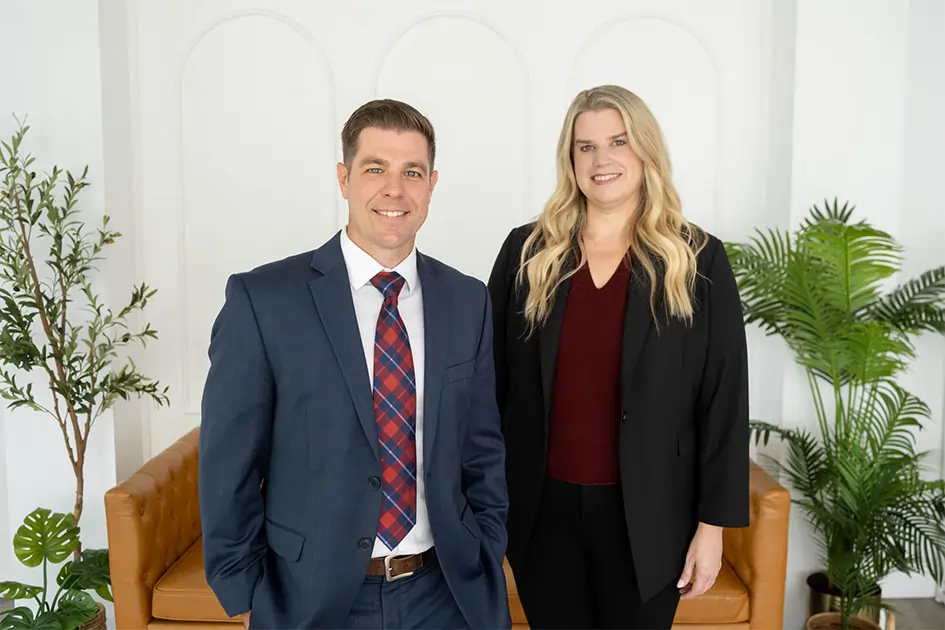
Julie L. Glover and Adam R. Luck founded Glover Luck LLP in 2014, and both are accredited by the VA to represent veterans nationwide. Julie Glover holds a Juris Doctor from Texas A&M School of Law, an LL.M. in Taxation, and a Master of Education, and she has spoken on veterans law at legal conferences and law schools. Adam Luck holds a degree in finance and business administration from Kansas State University and advised service members as a financial advisor before entering practice. Veterans throughout Tarrant County come to our veterans disability lawyer in Fort Worth, TX with claims at every stage.
Understanding Service-Connected Disability Cases
What Are Important Aspects of a Service-Connected Disability Case?
Nearly every claim is decided on the same three questions, whatever the condition. The evidence required to answer them is what varies.
- Establishing a current diagnosis supported by medical evidence
- Identifying an in-service event, injury, exposure, or period of service
- Connecting the two through medical evidence, presumption, or lay evidence where permitted
- Documenting severity against the criteria in the rating schedule
- Preserving the earliest effective date the record supports
The agency carries obligations of its own in this process. It must notify a claimant of the evidence needed and must make reasonable efforts to obtain records the veteran identifies, including federal records, where the agency’s duty is more demanding still. A decision reached without those steps may be challenged on that basis.
What Is The Service-Connected Disability Case Timeline?
These claims proceed on the ordinary VA schedule, and the examination is usually the point at which the outcome takes shape.
- An intent to file preserves the effective date while evidence is gathered
- The claim is filed with medical records and evidence of the in-service event
- The VA requests records and schedules an examination where one is needed
- The regional office issues a rating decision
- An unfavorable decision may be challenged within one year of the notice
Several review routes follow a denial, and they differ in what evidence may be submitted and how long each takes. A veteran whose condition worsens after a rating is assigned may seek an increase at any time, and ratings held for long periods carry protections against reduction.
What Should You Bring to Your Service-Connected Disability Consultation?
A first meeting is more productive when the central records are together. Where they are available, we ask veterans to bring the following:
- The DD-214 and any orders, evaluations, or assignment records
- Service treatment records and records of care received since separation
- Any VA decision letters or rating decisions already issued
- Employment records reflecting absences or changes in duties
- Statements from family members, colleagues, or others who observed changes
We will discuss what the record appears to establish, which route to service connection the circumstances support, and whether the evaluation reflects the documented severity.
Routes to Service Connection, Ratings, and Compensation
Service connection may be established in several ways, and more than one may apply to the same veteran:
- Direct service connection, where evidence links the condition to an event, injury, or illness during service
- Presumptive service connection, where the law presumes a link based on service in a designated location or period
- Secondary service connection, where a condition results from or is aggravated by one already service connected
- Aggravation, where service worsened a condition that predated enlistment beyond its natural progression
- Compensation under Section 1151, where VA medical care caused additional disability
Once established, the condition is evaluated under a rating schedule intended to reflect average impairment in earning capacity. Where the evidence raises a question between two evaluation levels, the higher is assigned if the disability picture more nearly approximates its criteria. The same disability may not be rated twice under different diagnostic codes, which is a limitation that frequently arises where one condition produces effects across several body systems. Compensation is paid monthly at the rate corresponding to the combined evaluation, with additional amounts for dependents.
What Are Important Texas Legal Resources for Service-Connected Disability Cases?
These claims are governed by federal regulation, and the rules the agency must follow are published in full. A veteran who wants to read them can begin with the sources below, none of which replaces representation.
- 38 CFR 3.159 sets out the agency’s obligation to notify a claimant of the evidence required and to assist in obtaining it.
- 38 CFR 4.1 explains that percentage ratings are intended to represent average impairment in earning capacity.
- 38 CFR 4.7 directs that where two evaluations are in question, the higher is assigned if the disability picture more nearly approximates its criteria.
- 38 CFR 4.14 addresses pyramiding, the rule against evaluating the same disability under more than one diagnostic code.
- The general policy provisions of Part 4 collect the related rules on reasonable doubt, interpretation of examinations, and functional impairment.
Reach Out to Glover Luck LLP to Schedule a Consultation
A denial is a decision on the evidence the agency had in front of it, not a final judgment on what your service cost you. Our Fort Worth service-connected disability lawyer can review the record and explain which routes remain available. Contact us to arrange a consultation at no cost. Glover Luck LLP represents veterans and their families throughout Tarrant County.
If you need assistance appealing your service-connected disability claim, please contact our veterans law office for a free consultation at 866-849-3287 or 214-741-2005. We are based in Dallas, Texas, and represent veterans all over the United States.