Trusted VA PTSD lawyers serving clients across California for over twelve years.
If post-traumatic stress disorder from your military service has gone unrecognized or undercompensated, a California VA PTSD lawyer can help you secure the benefits you are entitled to. Glover Luck LLP has spent more than twelve years representing veterans in disability claims, appeals, and hearings. Our attorneys are accredited by the Department of Veterans Affairs and advocate for veterans across the country. Reach out to discuss your PTSD claim with our office.
VA PTSD Lawyer California
PTSD is one of the most common conditions for which veterans seek disability compensation, yet it remains among the hardest to prove. The condition develops after a traumatic event during service, and its symptoms, including intrusive memories, hypervigilance, and disrupted sleep, can disrupt work and family life for years. Many veterans live with these effects long before they connect them to their service or pursue a claim.
A VA PTSD claim asks the agency to recognize that condition as service-connected and to assign a rating that reflects its severity. To succeed, a veteran generally must establish a current diagnosis, an in-service stressor, and a medical link between the two. A diagnosis alone, even one from a VA facility, does not guarantee benefits, because the agency still requires proof that service caused the condition. The VA evaluates how the condition affects daily functioning, and that evaluation drives the level of compensation a veteran receives.
Types of VA PTSD Cases We Handle in California
No two PTSD claims have the same facts. The stressor differs, the symptoms differ, and the evidence needed to connect the condition to service differs with them. A veteran whose trauma traces to combat faces a different evidentiary task than one whose condition stems from an assault that was never reported. Our attorneys represent veterans across the full span of these claims.
- Combat-related PTSD claims. Trauma from combat is among the most recognized bases for a PTSD claim. We help document the stressor and the symptoms that followed, drawing on service records and unit history. In many combat cases, a veteran’s own account of the stressor can carry significant weight.
- Military sexual trauma claims. PTSD arising from assault or harassment during service often lacks a paper trail. We help veterans identify the markers and supporting evidence the VA accepts in these cases, including records of behavioral changes that corroborate the event.
- PTSD from accidents or training. Serious accidents and high-stress duties can produce lasting trauma, even outside of combat. We work to connect the diagnosis to the in-service event that caused it and to show how the condition persisted afterward.
- Secondary conditions tied to PTSD. PTSD frequently gives rise to other disabilities. We pursue secondary service connection for conditions such as sleep apnea, depression, and chronic pain that develop alongside it.
- Claims for an increased rating. A rating that understates the severity of PTSD shortchanges a veteran. We pursue a higher rating when symptoms have worsened or were underevaluated.
- Appeals after a denial. A denied PTSD claim is not the end of the road. We carry cases forward after an initial claim denial through higher-level review, supplemental claims, and Board appeals.
- Unemployability based on PTSD. When PTSD makes steady work impossible, individual unemployability can provide compensation at the total rating even short of a one-hundred percent schedular evaluation.
VA PTSD Lawyer California: Why Choose Glover Luck LLP?
We devote our practice entirely to veterans law. That singular focus informs how we prepare and present every PTSD claim, from the first filing through appeal.
Attorneys Accredited to Represent Veterans Nationwide
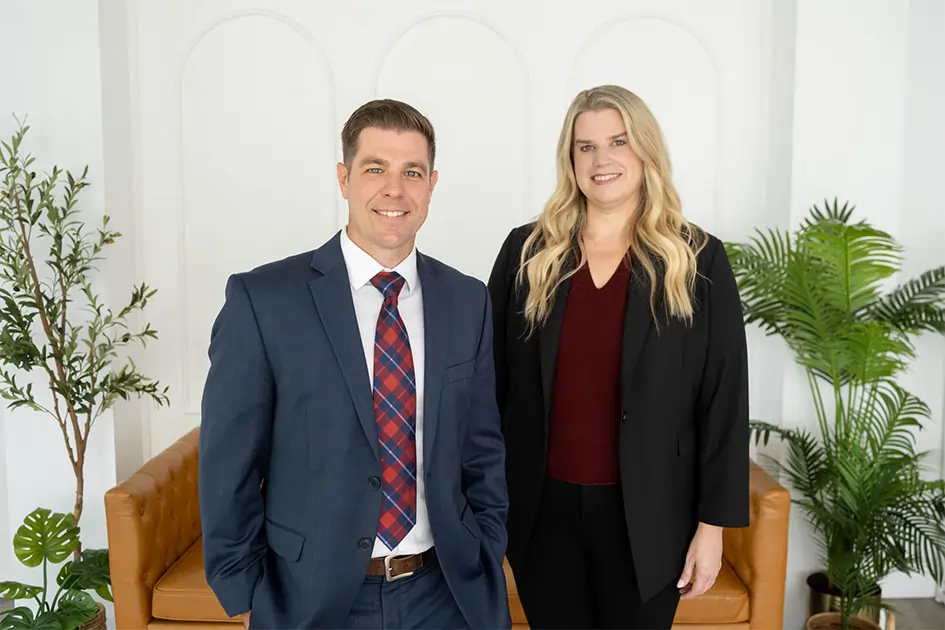
Adam R. Luck co-founded the firm and represents veterans across the VA disability process, including pension claims, discharge upgrades, and tort matters against the agency. Before practicing law, he advised service members and veterans as a financial advisor, work that exposed him to the legal needs the firm was later built to serve. Julie L. Glover co-founded the firm alongside him and handles claims at every stage, from the initial application through proceedings against the VA. Both hold accreditation from the Department of Veterans Affairs to represent veterans nationwide, and both are members of the National Organization of Veterans’ Advocates.
A Practice That Reaches the Courts
Our work does not stop at the regional office. We represent veterans before the U.S. Court of Appeals for Veterans Claims and at every stage of the appeals process. PTSD claims often hinge on how clearly the medical evidence ties symptoms to a documented service stressor, and we know how to develop that record over time. For more than a decade, our firm has taken on claims that stalled and denials that veterans were told were final. As a VA disability lawyer in California, we have seen how a thorough stressor statement and a well-supported medical opinion can change the course of a claim that previously went nowhere. We represent veterans and their families, and we offer free consultations for PTSD claims, so an initial review costs nothing.
What Is Important to Understand About VA PTSD Cases?
Stressors, Diagnosis, and Compensation for PTSD Claims
A PTSD claim has several connected elements. Knowing what each one requires helps a veteran understand what the VA weighs and where a claim can weaken. Each element stands on its own, and a gap in any single one can hold up the entire claim.
- Current diagnosis. A qualified mental health professional must diagnose PTSD under the recognized clinical criteria.
- In-service stressor. The traumatic event must have occurred during service, whether combat, assault, or another qualifying experience.
- Medical nexus. A professional opinion linking the diagnosis to the stressor is often the pivotal piece of evidence.
- Disability rating. The VA assigns a percentage based on how severely PTSD impairs work and social functioning.
- Effective date. This sets how far back compensation reaches, which can affect years of benefits.
Veterans whose symptoms surfaced only after leaving the military often ask about conditions diagnosed after service, since PTSD can take time to emerge.
What Are Important Aspects of a VA PTSD Case?
The outcome of a PTSD claim usually turns on the quality of the evidence and how clearly the stressor is documented. A few elements carry particular weight.
- The stressor statement describing the traumatic event in detail.
- The medical evidence establishing the diagnosis and its severity.
- The nexus opinion connecting the condition to service.
- The record of how symptoms affect daily work and relationships.
Building that record early matters. Knowing what counts as evidence helps a veteran assemble a claim that holds up under VA review.
What Is the VA PTSD Case Timeline?
PTSD claims move through a defined sequence, though the pace varies with the VA’s workload and the complexity of the evidence. A typical claim follows several steps.
- Gathering the diagnosis, stressor statement, and supporting records.
- Filing the claim and attending a VA examination.
- Receiving the initial rating decision from the regional office.
- Seeking higher-level review or a supplemental claim if the decision is inadequate.
- Appealing to the Board of Veterans’ Appeals when further review is justified.
The compensation and pension examination often shapes the result, so understanding how to prepare for examinations can make a meaningful difference.
What Should You Bring to Your VA PTSD Consultation?
Arriving with the right materials lets us evaluate a claim more precisely. Helpful documents include the following.
- Service records, including any showing the stressor or related events.
- Medical and mental health records reflecting a PTSD diagnosis.
- Any prior VA decisions or correspondence.
- A personal account of the traumatic event and its ongoing effects.
We use the consultation to review these materials, outline the available options, and answer your questions. We work to keep veterans informed at each stage and to respond without unnecessary delay. There is no obligation to retain our firm after that initial review.
What Are Important California Legal Resources for VA PTSD Cases?
VA disability claims are decided under federal law, so the most reliable resources are federal rather than California state sources. Because the standards apply nationwide, a veteran’s location does not change how a PTSD claim is judged. The following references help veterans understand how PTSD claims are evaluated.
- The VA PTSD eligibility page explains the requirements for compensation based on service-related trauma.
- The VA stressor statement form supports a PTSD claim by documenting the traumatic event.
- The principles of service connection for PTSD in Title 38 set out the evidentiary rules that govern these claims.
- The Board of Veterans’ Appeals describes how appeals are reviewed and decided.
Reach Out to Glover Luck LLP to Schedule a Consultation
If service-connected PTSD has affected your life and your benefits do not reflect it, our California VA PTSD attorneys are ready to help. We offer free consultations and represent veterans through every stage of the claims and appeals process. During your consultation, we will review your records and explain the path forward in plain terms. Contact us to get started today.
VA PTSD Claim Statistics in California

California is home to more veterans than any other state, and many of them carry the effects of service-related trauma. Post-traumatic stress disorder occurs more frequently among veterans than among civilians, and the rate climbs higher among those who deployed. That pattern holds from San Diego County to the Bay Area, which is why PTSD remains one of the conditions our California VA PTSD lawyers see most often.
Prevalence figures also explain why so many claims turn on evidence rather than on the condition itself. A veteran may live with symptoms for a decade before anyone names them. The VA still asks for proof that service caused the condition, and the numbers below show how widely that question reaches veterans in CA.
- Nearly 1.5 million veterans live in California, roughly eight percent of the national veteran population.
- About 7 out of every 100 veterans will have PTSD at some point in their lives, compared with 6 out of every 100 adults in the general population, according to VA data on PTSD.
- Among veterans who served in Iraq or Afghanistan, 29 out of every 100 have had PTSD at some point, and 15 out of every 100 experience it in a given year.
- Persian Gulf War veterans report PTSD at a lifetime rate of 21 out of every 100.
- Among veterans who use VA health care, 23 out of every 100 have had PTSD in their lifetime, roughly three times the rate among veterans who receive care elsewhere.
Mistakes That Can Damage Your California VA PTSD Claim
Most PTSD denials do not happen because a veteran lacks a legitimate condition. They happen because something in the record was thin, late, or missing. These are the errors we see most often in claims that have already gone wrong.
- Writing a vague stressor statement. A statement that describes fear or danger in general terms gives the rater nothing to verify. Dates, locations, unit assignments, and the names of others present carry more weight. We help veterans reconstruct those details from service records.
- Assuming a diagnosis settles the question. A PTSD diagnosis from a VA provider establishes that the condition exists, not that military service caused it. Without a medical opinion connecting the two, an otherwise strong file still comes back denied.
- Understating symptoms at the examination. Veterans often minimize what they are experiencing during a compensation and pension examination, whether out of habit or out of pride. The examiner records what is said that day, so being aware of what examiners look for helps a veteran describe symptoms accurately.
- Leaving out lay evidence. Statements from a spouse, an adult child, or a fellow service member capture changes that no clinical note records. These accounts show how symptoms affect work and relationships, which is what the rating criteria measure.
- Filing a new claim instead of pursuing review. Starting over can cost a veteran years of retroactive pay. Supplemental claims and higher-level review usually preserve the original filing date while the evidence is strengthened.
- Overlooking the effective date. Compensation reaches back to a specific point, and that point is frequently earlier than the VA assigns. Veterans who never question the effective date may lose back pay that was properly theirs.
- Ignoring conditions that grew out of PTSD. Sleep disorders, depression, anxiety, and chronic pain frequently follow a PTSD diagnosis. Each may support a separate rating, and veterans who never raise them are compensated for part of the picture only.
- Treating harassment or assault claims like combat claims. Evidence in military sexual trauma claims often comes from performance records, transfer requests, or documented changes in behavior rather than from an incident report. A veteran who assumes no report means no claim may abandon a case that could succeed.
- Missing a decision deadline. Each VA decision carries a window for further review, and those windows close. A veteran who lets one pass usually starts over with a later effective date.
- Waiting to involve a VA PTSD attorney in California. A file denied twice takes more work to repair than one built correctly at the outset. Our attorneys often take over claims that stalled years earlier and rebuild the record.
California VA PTSD Lawyer FAQs
How are attorney fees handled in a VA PTSD case?
Our fees in VA disability matters are paid from past-due benefits recovered on the claim, so representation requires no payment out of pocket while a case is pending. Fee agreements are filed with the VA and reviewed by the agency, and we explain the arrangement in writing before representation begins.
Do I need a lawyer to file a PTSD claim?
No. Veterans may file on their own or work with an accredited representative at no cost, and many do so successfully. Legal help matters most after a denial, after a low rating, or when the evidence connecting a stressor to service is hard to locate. Our California VA PTSD attorneys handle a large volume of claims in that posture.
How long does a VA PTSD claim take?
Timelines vary with the evidence involved and the VA workload. An initial claim commonly takes several months. Higher-level review and supplemental claims add time, and appeals to the Board of Veterans’ Appeals can run beyond a year. We work to avoid delays caused by incomplete submissions.
Can I win a claim if the trauma was never reported?
Yes. Unreported assault and harassment claims are decided on markers rather than incident reports. Transfer requests, declining evaluations, disciplinary changes, and medical visits for unrelated complaints all serve as corroboration. A PTSD lawyer in CA can identify which parts of a service record carry that weight.
What rating will the VA assign for PTSD?
Ratings reflect how much the condition impairs occupational and social functioning, not how severe the diagnosis sounds. Two veterans with similar symptoms can receive different evaluations depending on how well the record documents daily effects. When a percentage understates that impairment, we pursue an increase supported by treatment records and lay statements.
Can the VA reduce a PTSD rating after it is granted?
It can, usually after a reexamination suggests improvement. A veteran who receives notice of a proposed reduction may respond with evidence and request a hearing before anything changes. Our California rating reduction attorney practice exists for this situation, and the response deadline is firm.
Does living in California change how my claim is decided?
No. VA disability claims are governed by federal standards applied nationwide. Location affects practical matters, such as which medical facility performs your examination. It does not change the evidence required or the criteria used to evaluate VA disability compensation.
Can I work and still receive PTSD compensation?
Many veterans work while receiving benefits. Employment becomes relevant when a veteran seeks total disability based on individual unemployability, which pays at the total rate when service-connected conditions prevent substantially gainful work. Marginal employment does not necessarily disqualify a claim, and a California TDIU attorney can assess a particular work history.
What happens after a denial?
A denial is a decision, not a conclusion. The next step may be a supplemental claim with new evidence, a higher-level review by a senior adjudicator, or an appeal to the Board. We read the decision letter closely, because the stated reason for denial usually identifies which piece of evidence the file lacks.
Should I claim conditions that developed after PTSD?
Yes, when the medical evidence supports the connection. Sleep apnea, depressive disorders, and chronic pain are commonly linked to service-connected PTSD. Veterans pursuing mental health claims beyond a single diagnosis often see a change in their combined evaluation.
Important Resources for California VA PTSD Cases
California VA Regional Offices and Veterans Resources
Three VA regional offices serve California veterans. The Oakland VA Regional Office covers the northern part of the state, the Los Angeles Regional Office serves much of Southern California, and the San Diego Regional Office handles San Diego, Orange, Riverside, and Imperial counties. Because the VA distributes claims through a national work queue, the office nearest a veteran is not always the one that decides the claim. Veterans may also receive counseling at Vet Centers and treatment through VA medical facilities, and records from those visits frequently become evidence.
What Are Important Local Resources for California VA PTSD Cases?
Veterans preparing a PTSD claim in California often need treatment records, benefit counseling, or service documents.
- VA Greater Los Angeles Healthcare System, 310-478-3711, provides mental health care across Los Angeles, Kern, and Ventura counties.
- VA San Diego Healthcare System, 858-552-8585, treats veterans throughout San Diego and Imperial counties.
- County Veterans Service Offices, 800-952-5626, operate in every California county and assist with benefit applications at no charge.
Glover Luck LLP does not endorse the organizations listed above, and their inclusion reflects availability rather than any affiliation with our firm.
About Glover Luck LLP
Julie L. Glover and Adam R. Luck founded Glover Luck LLP in 2014, and the firm has practiced in veterans disability law for more than twelve years. Julie Glover holds a Juris Doctor from Texas A&M School of Law and an LL.M. in Taxation from the University of Alabama, and her practice extends to tort claims against the VA. Adam Luck volunteers at legal clinics for veterans held at VA medical centers through Texas Lawyers for Texas Veterans. Both attorneys are accredited by the Department of Veterans Affairs and represent veterans nationwide.
What Our Clients Say
★★★★★
“Julie and the team at Glover Luck LLP were absolutely wonderful to work with. They were kind, understanding and very knowledgeable about Veteran Law. I definitely recommend Glover Luck Law Firm if you need help in accomplishing your post military service benefits goals.”
Shawn Davis
Read more reviews on our Google Business Profile.
Additional Resources for California VA PTSD Cases
- Secondary Conditions: When PTSD Leads to Sleep Apnea or Chronic Pain
- Guide to Secondary Service Connection for Anxiety Disorders
- Depression Disability: Earning a VA Rating for Mental Health
- Service Connection for Mental Health Issues
- Your Guide to the VA Appeals Process
Contact Glover Luck LLP
If PTSD from your military service has been denied, underrated, or left unclaimed, our California VA PTSD lawyers will review the file and tell you plainly what it needs. Fees in VA disability cases are paid from past-due benefits recovered, so representation costs nothing out of pocket while a claim is pending. An initial review covers your service history, treatment records, and any decisions the VA has issued. We respond promptly and keep veterans informed as a claim develops. Contact us to begin.